By Rachel Knight, Founder of TitleSplit.com
Landlords are losing millions of pounds in equity, not because of the market, but because of how their properties are structured. In many cases, it comes down to a simple issue. They either don’t know they can Title Split, or they’ve been advised to leave it until they sell. On paper, that might sound harmless. In reality, it can significantly impact the value they achieve.
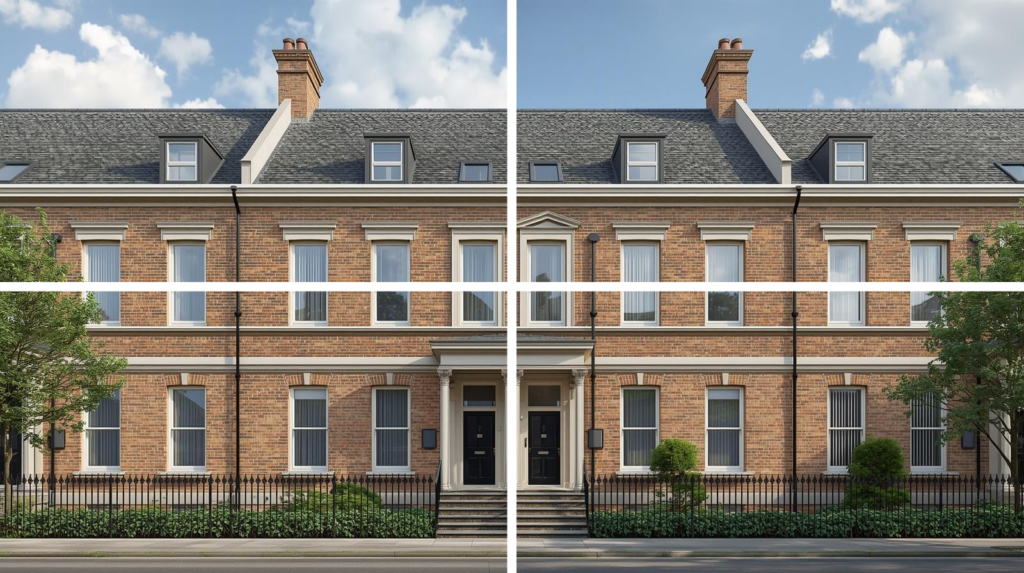
A large number of landlords own multi-unit freeholds (multiple properties sitting under a single freehold title). While these properties may have separate addresses, legally they are still treated as one asset.
This becomes a problem at the point of sale. When a multi-unit freehold is sold as a single title, it is typically valued at a wholesale level. Many landlords assume they can sell to another investor, with tenants in place, at full retail value. That simply isn’t how the market works. The valuation reflects the structure, not the individual units, and this often leads to disappointment for landlords looking to exit.
The benefit of Title Splitting these multi-unit freeholds is straightforward. Once split, individual units are able to grow in line with wider UK capital growth, rather than being tied to a single bulk valuation. Looking ahead, the biggest opportunity sits within what are known as unbroken freeholds.
An unbroken freehold is a property where two or more addresses exist on one freehold title. There are around 1,189,793 of these across England and Wales, owned by private landlords. Yet only 29,237 are currently on the market, just 2.46%. What this really highlights is how much of this opportunity sits off-market.
These properties take a number of forms:
- Unsplit blocks of apartments that already exist and require no planning permission to refurbish
- Multiple houses on one freehold where titles were never separated
- Mixed-use properties, such as a shop with flats above
- Farms with multiple barns, many already converted and rented but still held under one title
- Houses with an existing annex
- Commercial to residential conversions
- New homes where developer has decided to keep instead of sell
In each case, multiple units exist, but they are being treated as a single asset. Title Splitting changes that. By separating a freehold into individual freehold or leasehold titles, each unit can be valued on its own merit using local comparable sales. This shift in structure has a direct impact on value.
In most cases, this creates an immediate equity uplift of 25% to 35%. This is day-one uplift, based on comparable evidence, not future market growth.
There are properties on the market today where this potential already exists. For landlords and developers, this presents a more efficient way to grow a portfolio, benefiting from both capital uplift and cash flow from the point of purchase.
Examples of this can already be seen in practice, with Title Split client deals completed throughout 2025 demonstrating how this approach translates into real results.
£170K capital uplift: The Small Deal
Title Split Case Study Example – Converting a Church to 2 residential units
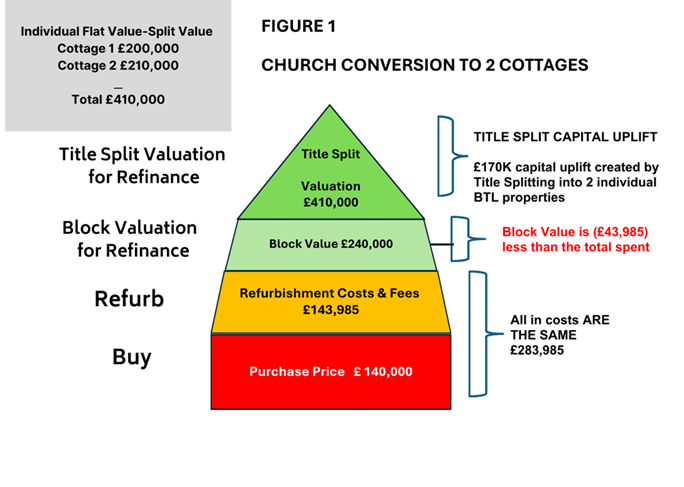
Purchase of a small commercial unit (User Class G -Church), in the East Midlands. The property was Title Split on Purchase and then fully refurbished to a high standard (pictures shown). See figure below for Title Split Profit Pyramid.
Purchase Price £140,000
Refurbishment & All Costs £143,985
Total Money into the deal £283,985
Unsplit RICS valuation after refurbishment based on rent and yield calculation £240,000. This is a loss of £43,985 on completion of the project.
Title Split Valuation (based on local comparable sales prices £410,000). This is £126,015 profit on day one (£170K more capital than the block valuation).
£1.4M Capital Uplift: The Big Deal
Title Split Client Case Study Example – Converting a Farm in 2025
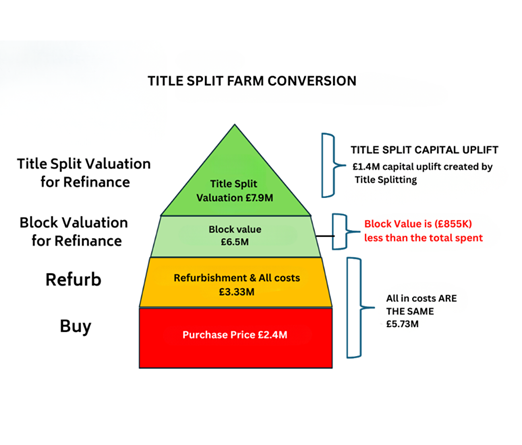
Purchase a small holding (7 barn and stable units in the Southeast of England). The property has been fully refurbished in 2024/2025 to a very high standard. The property developer has decided to keep all of the units and run them as a mixture of high-end serviced accommodation and buy-to-let investment properties. All units are to be individually financed on individual mortgages. The Split Value Uplift on this farm is £1.4M, simply by Title Splitting.
The numbers to make £1.4M extra profit
Purchase Price £2.4M
Refurbishment & All Costs £3.33M
Total Money into the deal £5.73M
Unsplit RICS valuation after refurbishment based on rent and yield calculation £6.5M
If mortgages were at 75% the mortgage amount would be £4.875M (leaving £855K in the deal if remortgaged).
Title Split Valuation (based on local comparable sales prices £7.9M). This valuation is £1.4M higher than the unsplit valuation.
Title Splits need to be done at the time of purchase, refinance or sale. They cannot be done at any other time. This is imperative to meet the bank borrowing requirements and legal requirements.
The Opportunity for Developers and Landlords who are buying MUFs and MUFBs
Title Splitting presents a clear opportunity for those looking to acquire property and grow their portfolios, whether that’s buy-to-let, commercial assets, or commercial-to-residential projects. At its core, it allows you to purchase a single property and turn it into multiple income streams, while also benefiting from individual capital growth across each unit. Instead of holding one asset, you’re effectively creating several, each with its own value and performance.
In addition, it is absolutely perfect for developers wanting to flip properties. MUFBs and MUFs very rarely require planning or permitted development as the units exist already. Having access to the right team and the right knowledge is crucial to making this happen. At TitleSplit.com, both buyers and sellers are supported in accessing the equity tied up in unsplit freeholds, currently estimated at over £115 billion.
Further information on Title Splitting and multi-unit freehold strategies is available through TitleSplit.com.